Unstoppable
Movement
Other devices send their signal to the muscle.
Ours goes to the foot — and the brain reads it as timing.
Find your stride,
one step at a time.
NUSHU is a pair of smart shoes. Sensors in the soles read every step you take, and gentle vibration cues — delivered in real time, under the foot — help you walk more confidently and stay active in daily life.
It is a medical device: CE Class IIa, FDA cleared, and in use across more than twenty countries, at home and in the clinic.
The technology helps you reconnect with your feet, so that walking feels more natural, more confident, and more in your control.
The signal doesn't arrive.
In Parkinson's, the brain's own timing signal — the internal beat that starts a step and paces the next one — becomes unreliable. The pathway from brain to leg is intact. What has gone is the rhythm: the message is late, or quiet, or it never comes at all.
In multiple sclerosis and after a stroke the damage is different again. What the three have in common is not the lesion. It is that walking stops being automatic.
This is what freezing of gait is. Not an absence of will — the person is trying to walk. And effort is not what releases it; attention is. A cue from outside can do what trying harder cannot.
Which is the opening. If what failed is the timing of the message, then timing is the thing to supply.
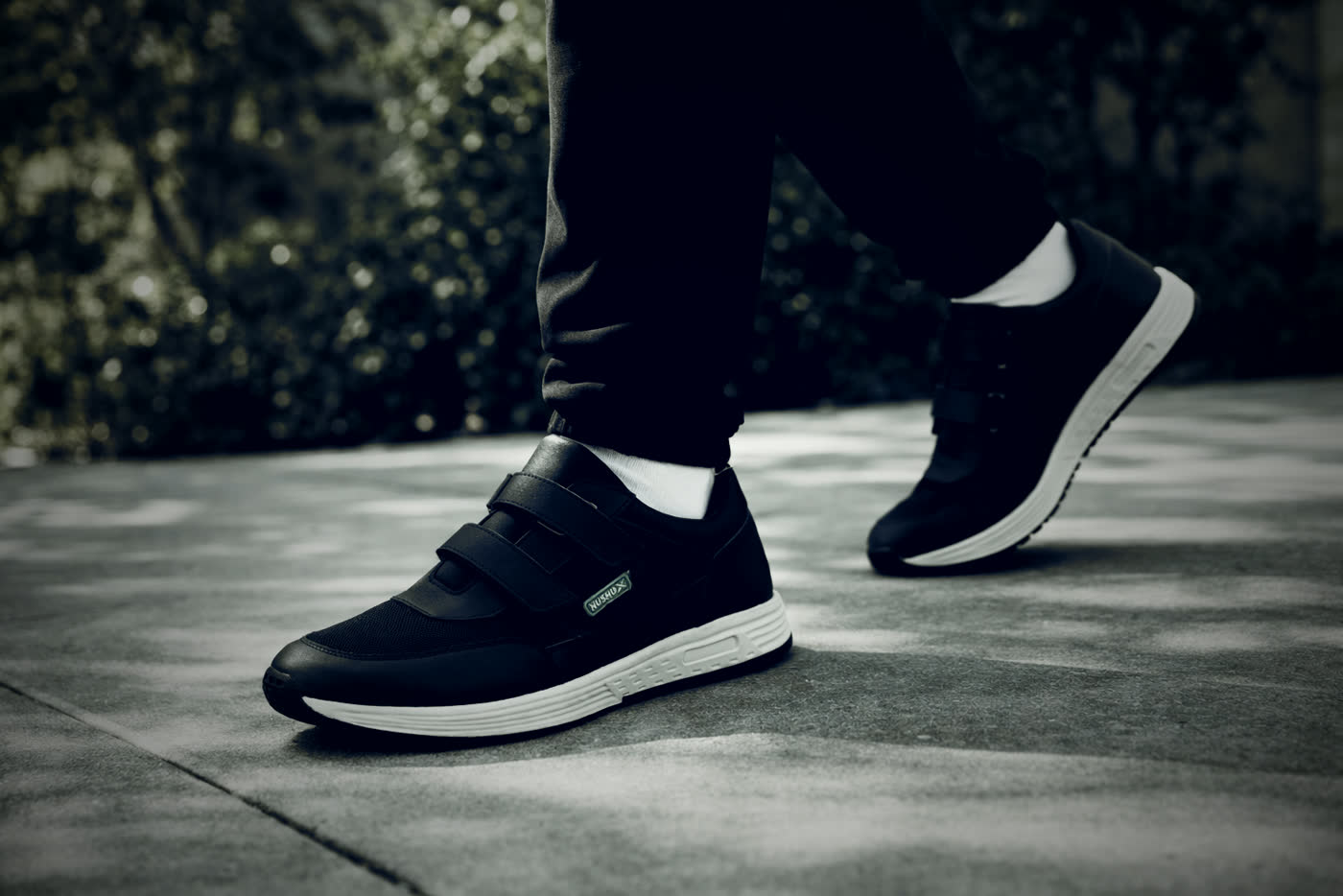
Forty gait parameters, from a shoe you put on like any other.
Measured where people actually walk.
Stairs, gravel, a supermarket aisle, a bad morning. Gait laboratories never see any of it.
We write into the
sole of the foot.
NUSHU does not move the leg. It opens a second channel — a gentle vibration delivered to the sole, light enough to wear all day, which the nervous system can read as timing.
The brain still issues the step. NUSHU supplies the cue alongside it, at the moment in the step where a cue is useful. Whether that support carries over once the shoes come off is what our clinical partners are studying now.
Sense
Sensors in both shoes read every step: cadence, symmetry, swing, balance. Over forty gait parameters.
Decide
The shoe's embedded processor detects gait events as they happen and times the cue to the step, in the feedback mode chosen for that wearer.
Cue
A vibration reaches the sole at the point in the step where it helps. Gentle enough to live with all day; clear enough to walk to.
Act
The nervous system reads it and produces a step. The sensors read the result, and the next cue lands accordingly.
The loop closes inside the step — and it closes on the wearer's own nervous system, not on the muscle.
Nüshu was a language
for what could not
be said otherwise.
In Hunan, women shut out of the official script wrote one of their own and passed it between themselves for generations. The oldest Chinese medicine already looked to the sole of the foot as a way to reach the rest of the body.
NUSHU takes the same route. It writes into the sole, in a language the nervous system can read.
One overrides the body. The other works with it.
| Muscle stimulation | MAGNES NUSHU | |
|---|---|---|
| Where the signal lands | The muscle | The sole of the foot, then the nervous system |
| What drives the step | The device contracts the muscle | The wearer's own nervous system |
| What it supplies | Contraction | Timing |
| Where the loop closes | In the muscle | In the nervous system |
A stimulator strapped to the leg contracts the muscle on command, and for foot drop it does that well. It is a different tool for a different problem.
We are working on the timing, not the contraction. That is why our loop closes in the nervous system rather than in the muscle — and why what NUSHU asks of the wearer is that they do the walking.
The same man.
Ten seconds apart.
One continuous take. One camera. He is trying to walk the whole time.
Nothing changes but the cue.
No adjustment, no second attempt, no cut. The feedback switches on, and the step arrives.
This is a demonstration, not a trial result.
But it is the same person, in the same corridor, seconds apart, with one thing changed. Fifteen clinical trials are running on the rest.
Trusted by Harvard · Stanford · UC San Diego · CHUV · University Hospital Zurich · Northumbria
“For me, it's a real game changer. Not being able to walk without my stick is huge, it's massive. I haven't walked without a walking stick for years.”
“Magic, a miracle. The vibration timing is very good. I can start walking, and the effect is immediate. I use them every day.”
“The vibrations help me walk properly, I didn't look or feel handicapped anymore.”
Individual experiences, in wearers' own words. Results vary from person to person.
Give people back their stride.
Unstoppable Movement means two things at once. The determination to keep walking. And a movement of people who would rather be supported in moving than moved.
Magnes has been working on this in Zurich since 2014, and shipping since 2021.
Join the movement →